
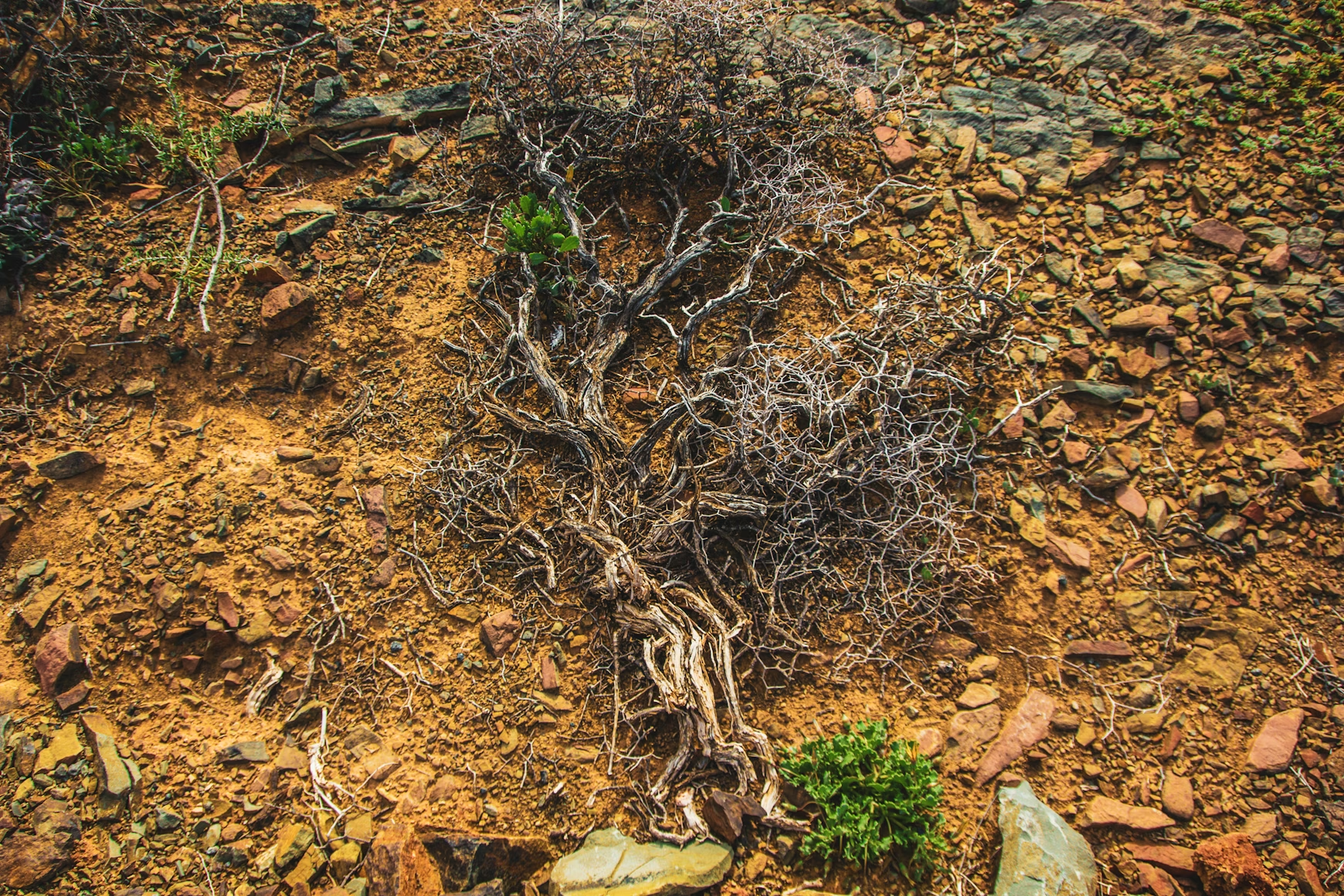

Why Roots Are the Foundation Everything Else Stands On
Any experienced grower knows the truth: you can have the best-looking tops in the field, but if the roots underneath are weak, shallow or sparse, the crop will disappoint when it matters most. Drought hits, nutrient deficiencies show up late, lodging increases, yields flatten out. I’ve watched it happen season after season.
Over the past fifteen years I’ve tried virtually every root-promoting product that has come to market – seaweeds, amino acids, phosphites, mycorrhizae, synthetic auxins, trichoderma products. Some work reasonably well. A few work very well in specific situations. But none have delivered as consistent and cost-effective root response across as many crops and soil types as good-quality potassium humate.
Potassium Humate simply keeps showing up in trial data, university studies and, more importantly, in commercial fields.
What Potassium Humate Actually Is
Potassium humate is the potassium salt of humic acids, almost always extracted from leonardite (highly oxidised low-rank coal). The better products come from specific deposits in North Dakota, New Mexico, Turkey or China that are particularly rich in active humic substances.
A typical high-grade potassium humate will contain:
- 65–85 % humic + fulvic acids
- 10–14 % K₂O
- 98–100 % water solubility
- pH in solution 9–11
The dark colour and complete solubility are what separate real potassium humate from cheap leonardite powder or partially soluble “humates” that leave half the bag undissolved in the tank.
How Potassium Humate Actually Works in the Soil and Plant
The effects are not magic; they are now quite well explained.
- Mild auxin-like activity Humic and especially fulvic fractions bind to auxin receptors and trigger the same gene expression pathways as natural IAA. The result is faster initiation of root primordia, longer root tips and far more lateral branching. The response is usually visible within 7–14 days.
- Chelation and mobilisation of nutrients The multiple carboxyl and phenolic groups on humate molecules tie up Fe, Zn, Mn, Cu, Ca in the soil solution and keep them plant-available even at high pH. In calcareous soils this alone can give a dramatic early-season root boost.
- Carbon and energy source for beneficial microbes A single kilogram of potassium humate supplies roughly 400–500 g of organic carbon in highly bioavailable form. Populations of Pseudomonas, Bacillus subtilis, Trichoderma and mycorrhizal fungi typically increase within days of application.
- Soil structural improvement Even modest rates (8–15 kg/ha) increase aggregate stability, reduce bulk density and improve water infiltration. Roots simply grow faster when they don’t have to fight compacted soil.
- Stress protection Humates induce higher proline accumulation, better membrane stability and stronger antioxidant enzyme activity. Roots keep growing when untreated plants have already shut down under drought or salinity stress.
Real-World Results I’ve Seen and Studies That Back Them Up
Tomato transplant trials (Spain, 2022–2024) → 48–67 % increase in root dry weight 30 days after dipping roots in 0.3 % potassium humate solution before planting. Plants established 7–10 days faster and gave 12–18 % higher early yield.
Peanut – water-deficit trial, 2024 → Potassium humate + cobalt gave 61 % longer roots and 44 % higher pod yield than the drought-stressed control.
Carrot – sandy soil, Turkey 2023 → 4 kg/ha potassium humate via fertigation produced thicker, smoother roots and 22 % higher marketable yield.
Wheat – seed treatment, India 2025 → 0.4 % potassium humate soak increased germination by 16 % and root length by 24 % in saline field conditions.
Turfgrass – multiple golf course trials (USA, Australia, Spain) → 300–450 % increase in root mass in the 8–20 cm layer within 8 weeks of two applications at 10 kg/ha each.
These are not cherry-picked numbers; they are typical of properly conducted trials with good-quality (>70 % humic acid) potassium humate.
Practical Application Rates That Actually Work
Seed treatment → 300–500 g per 100 kg seed (or soak in 0.3–0.5 % solution for 6–12 hours)
Root dip for transplants → 0.25–0.4 % solution (2.5–4 kg in 1000 L water), dip for 10–30 minutes
Drip / fertigation → 4–8 kg/ha total, split into 3–5 applications from early vegetative stage onward
Foliar (especially useful for quick response) → 1.5–3 kg/ha in minimum 300 L water, 2–3 times at 10–14 day intervals starting at 4–6 leaf stage
Base dressing or side-dress → 15–40 kg/ha worked into the seedbed or banded near the row in poor or compacted soils
I usually recommend starting with the middle of these ranges and adjusting according to soil analysis and previous experience.
Why I Keep Coming Back to Potassium Humate Instead of the Newer, More Expensive Alternatives
- Works in almost every soil type (except extremely acidic peat soils)
- Completely tank-mix compatible with almost everything except highly acidic mixtures
- No residue issues, no re-entry intervals, no phytotoxicity even at 5–10× rates
- Price per hectare is usually US $20–45 for a full-season root programme – very hard to beat
- The effect is visible to the naked eye; you can pull plants and see the difference
A Few Practical Tips From Years of Use
- Always buy from suppliers who provide a full analysis (total humic + fulvic, solubility, heavy metals).
- Store the powder or flakes in a dry place; once opened, it can pick up moisture and cake.
- Liquid formulations are convenient but check the real humic acid content – some are only 6–8 %.
- In very high-pH soils (>8.3), combine with some acidifying fertiliser to keep everything in solution.
- The response is strongest when plants are young and actively growing; don’t wait until mid-season to start.
How to Choose High-Quality Potassium Humate
1. Demand a Recent Certificate of Analysis
Any serious supplier will email you a CoA from the current batch without hesitation. Key numbers I require:
- Total humic + fulvic acids ≥ 70 % (dry basis) for flakes/crystals, ≥ 60 % for good powder (80–85 % is common in top-grade shiny flakes, 90–98 % claims are usually marketing nonsense or measured by unreliable methods)
- Water solubility ≥ 98 % (99–100 % is standard for premium products)
- K₂O 10–15 % (12–14 % is the sweet spot)
- pH in solution 9–11
- Moisture ≤ 15 % for flakes, ≤ 10 % for crystals
- Heavy metals well below limits (As < 10 ppm, Pb < 20 ppm, Cd < 2 ppm, Hg < 1 ppm)
If they cannot provide this, walk away.
2. Source of Raw Material – This Is the Single Biggest Quality Factor
The best potassium humate comes from high-grade leonardite deposits, particularly:
- North Dakota / New Mexico (USA)
- Anatolia (Turkey)
- Saxony (Germany)
- Certain deposits in Inner Mongolia or Xinjiang (China – but only specific mines)
These deposits are naturally high in active humic substances and low in inert material. Avoid products that simply say “lignite” or “brown coal” without specifying the deposit – many Chinese and Indian products use low-grade oxidised coal with only 30–40 % active matter before processing.
3. Physical Appearance Tells You a Lot (Especially for Flakes/Crystals)
Top-grade potassium humate flakes are:
- Shiny, almost glassy black (not dull or greyish)
- Uniform size, brittle, break cleanly
- Dissolve instantly in cold water with almost no residue
Good crystals are jet-black, diamond-like, and dissolve completely within seconds.
If the flakes are dull, brownish, sticky, or leave sediment after dissolving → low grade or poorly processed.
For liquid products I want minimum 12–15 % humic acid (many cheap liquids are only 6–8 % and mostly water + dye).
4. Simple Home Tests You Can Do in 5 Minutes
- Solubility test: 1 g in 100 ml cold tap water → must dissolve 100 %, solution should be crystal-clear dark brown/black with no particles settling after 30 minutes.
- Foam test: shake the solution vigorously → premium material produces stable creamy foam that lasts several minutes (indicates high molecular weight fraction). Cheap products give almost no foam.
- Smell: good potassium humate has a mild earthy/woody smell. If it smells strongly of ammonia, chemicals, or sour → reject immediately (sign of poor processing or adulteration).
5. Extraction Method Matters More Than Most People Realise
The best products today (2025) use alkaline extraction (KOH) followed by careful purification but without high-temperature drying that destroys active groups. Some premium manufacturers now use membrane filtration or low-temperature vacuum drying to preserve more fulvic acid and bioactive fractions. Avoid anything that mentions “nitrohumic acid” or “sulfonated” – these are lower-grade modified products.
6. Price Reality Check
Real high-quality potassium humate flakes (80–85 % humic, 98–100 % soluble) currently cost suppliers around US $1,800–2,500 per ton FOB (2025 prices). If someone is offering “98 % humic acid” flakes at $800–1,200/ton → it is almost certainly low-grade material with inflated numbers from colorimetric testing.
I am happy to pay $2,200–2,800/ton for material I know works every single time rather than gamble on cheap alternatives.
7. Red Flags – Run Away If You See These
- No CoA or only a marketing brochure
- Humic acid content claimed above 90 % for flakes (physically almost impossible with full solubility)
- Dull, non-shiny flakes or powder that clumps
- Strong chemical/ammonia smell
- High ash content (> 20 %) listed
- Supplier refuses to send a 1–2 kg sample
- Price dramatically below market average
8. My Current Go-To Specifications (What I Buy in 2025)
- Super potassium humate shiny flakes
- Humic acid 80–85 % (ISO 19822 method)
- Fulvic acid 10–15 %
- K₂O 12–14 %
- Solubility 99.9 %
- pH 9.5–10.5
- Appearance: shiny black flakes 1–3 mm
- Source: certified leonardite (usually North American or Turkish)
With material meeting these specs I consistently see 40–70 % root mass increase in transplant crops and 15–25 % yield bumps in field trials.
Advice
Always start with a 20–50 kg sample and run your own side-by-side test. Pull plants at 14 and 28 days and compare root systems. The difference between good and great potassium humate is impossible to miss once you see it with your own eyes.
Final Thought
After testing dozens of products over many years, potassium humate remains the single most reliable, economical and versatile tool I know for deliberately building deeper, denser, healthier root systems.
When roots are visibly better, almost everything else – drought tolerance, nutrient efficiency, final yield, crop quality – tends to take care of itself.
If your crops are currently limited by poor establishment, shallow rooting or stress sensitivity, adding a proper potassium humate programme is very likely the highest-return decision you can make this season. The evidence, both scientific and practical, is overwhelming.


Leave a Reply