

Potassium fulvate is widely used by farmers around the world as a straightforward soil conditioner that delivers noticeable improvements in soil structure, water handling, nutrient availability, and biological activity. Potassium fulvate comes mainly from weathered coal deposits—leonardite or lignite—extracted with an alkaline process to produce the potassium salt of fulvic acid. Because the molecules are small (usually 300–500 Da), it dissolves completely in water very quickly, works across a wide pH range, and penetrates soil layers faster than most humic-based products.
Many growers choose it specifically when they need quicker results compared to regular potassium humate. Potassium humate tends to build soil structure slowly over months or even years, while potassium fulvate gives more immediate effects on nutrient release, root stimulation, and microbial activity. In practice, a lot of people use both: fulvate for fast correction and humate for longer-term rebuilding.
What actually happens in the field when you apply it
After several seasons of use, farmers typically see these changes:
- Soil particles start sticking together better into small, stable crumbs instead of clumping into hard lumps or turning to dust. Water soaks in more easily instead of running off or ponding on the surface.
- Compacted layers loosen up, especially in clay soils that used to be sticky and poorly drained or in sandy soils that dried out too fast.
- Roots grow deeper and branch out more—often described as “whiter and fuller” when you dig a sample. This helps plants pull water and nutrients from a bigger volume of soil.
- Phosphorus that used to stay locked up by iron, aluminum, or calcium becomes more available because fulvate keeps it in a soluble form plants can take up.
- Nitrogen losses drop because less ammonia escapes into the air, and micronutrients like iron, zinc, and manganese stay available instead of turning into insoluble oxides.
- In salty or sodic soils, harmful sodium gets displaced and electrical conductivity comes down, so seedlings establish better and suffer less tip burn or stunting.
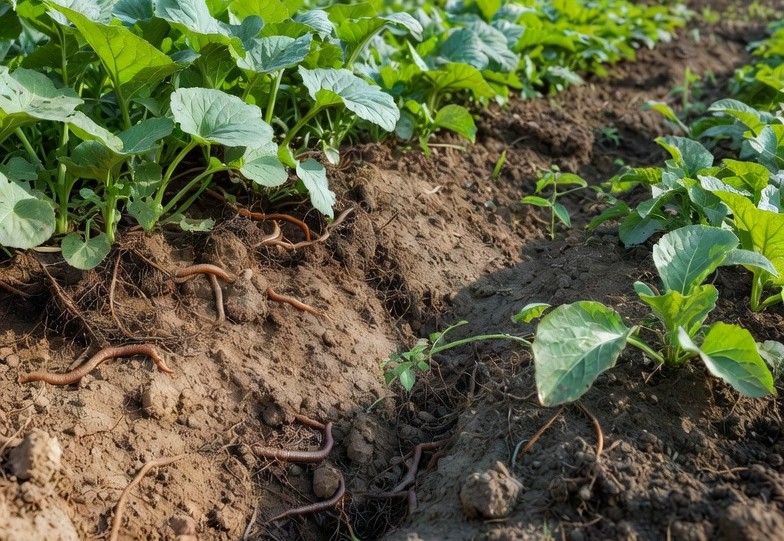
- Microbial life picks up noticeably—more earthworms, faster breakdown of crop residues, less root rot, and fewer outbreaks of soil-borne diseases in continuous cropping.
These improvements build gradually. The first season usually brings better seedling vigor and greener leaves; by the second or third year the soil feels softer, drains better after heavy rain, and holds moisture longer during dry spells.
Real examples from different farming situations
- Intensive vegetable fields (tomato, cucumber, bell pepper, leafy greens): Growers who fertigate 2–4 kg/ha every 10–15 days during the main growth period report firmer fruit, less cracking or blossom-end rot, darker foliage with fewer yellow patches, and marketable yields up 15–25%. Roots look much healthier when beds are opened.
- Citrus, pome, and tropical fruit orchards (orange, apple, durian, pomelo, mango): Applying 5–10 kg/ha around the drip line before flowering, plus one or two foliar sprays, often leads to more even bloom, better fruit set, fewer drop-offs, larger size, and improved color and sugar content. Trees bounce back faster after drought, heat waves, or waterlogging.
- Cereal and grain crops (wheat, maize, rice, barley): Pre-planting incorporation of 4–8 kg/ha in low-fertility or saline patches helps with stronger tillering, fuller heads, better grain fill, and cleaner straw. Yield lifts of 10–20% are commonly reported when baseline soil was poor.
- Specialty and stress-prone crops (cotton in dry zones, tobacco in rotation, ginseng, medicinal herbs): Regular moderate doses reduce stress symptoms, improve quality grades, and cut disease pressure by supporting a more balanced microbial environment.
How growers usually apply it in practice
- Before planting: Mix 4–10 kg/ha into the top 10–15 cm. Many combine it with well-rotted manure, compost, or phosphate to kick-start the root zone.
- Through drip or sprinkler systems: 1–3 kg/ha per irrigation cycle, repeated every 10–15 days when the crop is actively growing.
- Foliar sprays: 0.5–2 kg/ha diluted in 600–1000 liters of water per hectare. Spray early morning or late afternoon, 2–3 times during flowering and fruit development.
- Compatibility notes: Works fine with most granular or liquid NPK, urea, and trace elements. Always do a small bucket test first if the water is very hard or high in calcium/magnesium.
- Observation tips: Check root color and length after the first few applications, watch leaf color, and note how the soil feels when you walk the field after rain. Soil sampling every 12–18 months helps track organic matter, pH, and salt trends.
Choosing a product that actually works
- Look for fulvic acid content of at least 50–70%. Lower percentages often give weaker or inconsistent results.
- It should dissolve 100% in water with no grit or floating bits left behind.
- Ask for a recent analysis sheet showing fulvic acid level, potassium oxide (usually 8–12%), and heavy metals well below safety limits.
- Mineral-derived (leonardite or lignite) sources tend to be more consistent than some biochemical extracts.
- Buy from suppliers who provide batch certificates and have farmer feedback or trial data available.
Potassium fulvate is not a magic fix or a complete replacement for good management practices, but it addresses several common soil problems at once—poor structure, locked-up nutrients, salinity issues, and weak biological activity. When used regularly with reasonable rates and good-quality material, potassium fulvate helps build more forgiving, productive soils that support consistent yields and better crop quality even when weather or market conditions turn difficult. Over time, many farmers find they can ease back slightly on some fertilizer inputs while still maintaining performance, which improves both economics and long-term soil health.
Comparison to Potassium Humate
- Potassium fulvate acts faster due to smaller molecules—quicker chelation, penetration, and microbial response—while potassium humate builds structure more slowly over longer periods.
- Fulvate suits fertigation or foliar work without flocculation in hard water; humate fits base amendments for sustained aggregation.
- Many combine them for balanced short- and long-term gains.
Practical Notes on Realizing Benefits
Apply based on soil tests: higher rates for degraded soils, lower for better ones. Incorporate 4–10 kg/ha pre-plant, fertigate 1–3 kg/ha cyclically, or foliar 0.5–2 kg/ha at key stages. Monitor roots, leaves, and soil feel; test periodically to track changes in organic matter, pH, and salts.
Choose products with 50–70%+ fulvic acid, full solubility, verified low metals, and clear analysis. Mineral-derived sources perform more consistently in soil conditioning.
In conclusion, potassium fulvate addresses multiple soil issues—structure, water, nutrients, biology, salinity, and toxicity—in one application. Regular, thoughtful use supports more reliable yields, better quality, reduced input needs, and gradual soil restoration, making it a useful tool for sustainable farming under diverse conditions. Potassium fulvate is not a magic fix or a complete replacement for good management practices, but it addresses several common soil problems at once—poor structure, locked-up nutrients, salinity issues, and weak biological activity. When used regularly with reasonable rates and good-quality material, potassium fulvate helps build more forgiving, productive soils that support consistent yields and better crop quality even when weather or market conditions turn difficult. Over time, many farmers find they can ease back slightly on some fertilizer inputs while still maintaining performance, which improves both economics and long-term soil health.


Leave a Reply