
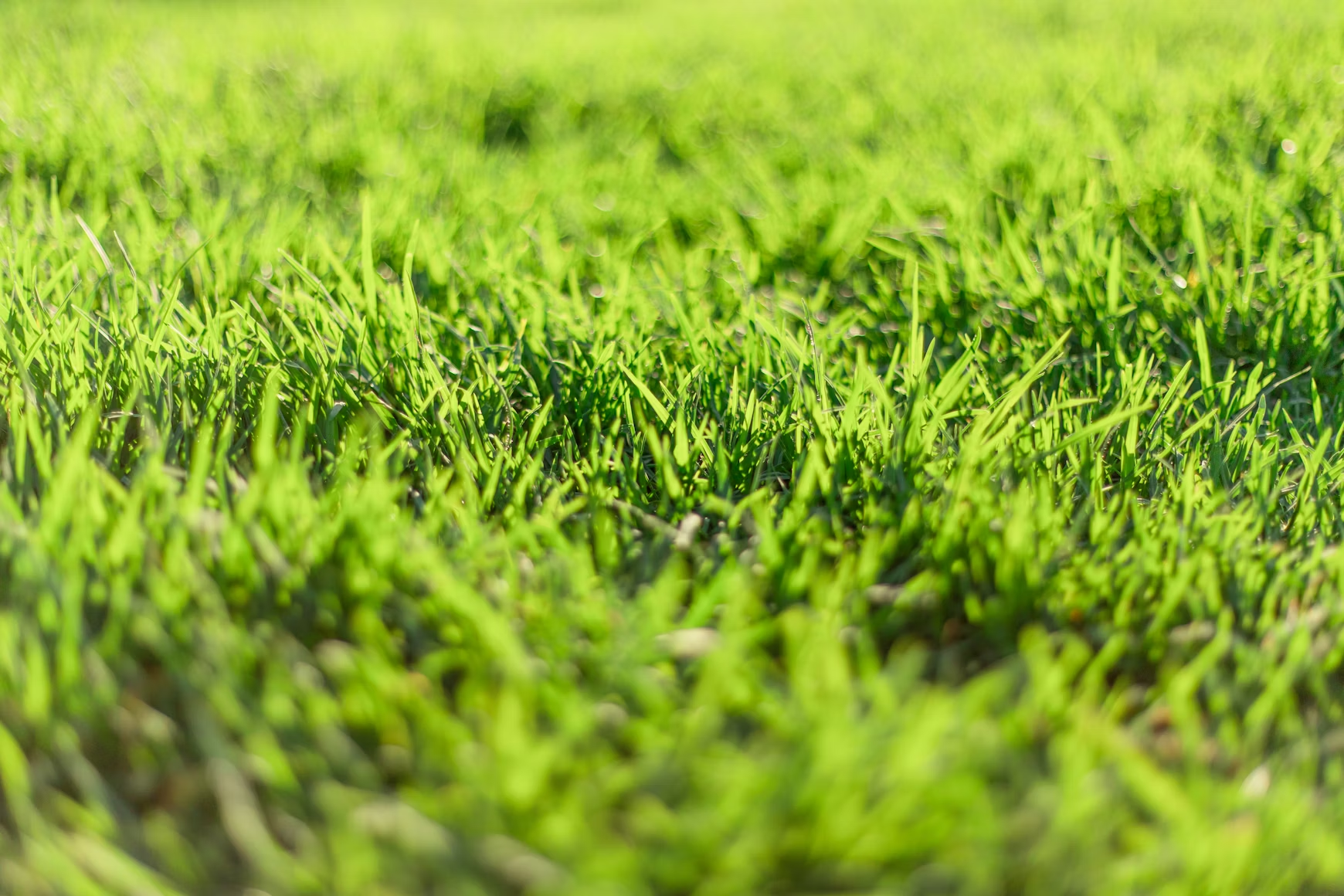

Granular humate, commonly referred to as granular humic acid or granular humic substances, consists of processed humic materials—primarily humic acid extracted from natural deposits such as leonardite, lignite, or similar ancient organic sources—compressed into small, uniform granules or pellets. This form allows for straightforward spreading over large areas and provides a gradual release of humic substances as the granules dissolve with soil moisture and irrigation. Unlike liquid formulations, granular humate integrates slowly into the soil profile, supporting sustained improvements in soil conditions over weeks to months.
Granular humate functions as a soil conditioner and biostimulant. Humate enhances cation exchange capacity, chelates nutrients to increase their availability, promotes beneficial microbial populations, and improves soil aggregation without supplying significant primary nutrients such as nitrogen, phosphorus, or potassium.
Primary Benefits for Lawns
The incorporation of granular humate into lawn maintenance programs yields the following advantages:
- Enhanced soil structure and reduced compaction — Granular humate fosters the formation of stable soil aggregates, thereby increasing porosity, improving aeration, and facilitating better root penetration in compacted or heavy clay soils.
- Increased water-holding capacity and drought tolerance — Humic substances bind water molecules effectively, reducing evaporation losses and enabling the turf to maintain hydration during periods of limited rainfall or irrigation.
- Optimized nutrient availability and reduced fertilizer needs — By chelating essential elements and minimizing leaching or fixation, it improves the efficiency of applied fertilizers, often allowing for a reduction of 10–25% in nitrogen inputs over successive seasons while maintaining or improving turf quality.
- Stimulated root growth and density — Applications promote extensive root development, including deeper roots and finer root hairs, which enhance anchorage, nutrient uptake, and overall plant resilience.
- Boosted microbial activity — It serves as a stable carbon source that supports soil microorganisms, contributing to improved organic matter decomposition and nutrient cycling.
- Improved turf appearance and vigor — Enhanced physiological processes frequently result in darker green coloration, denser stand, and greater uniformity, contributing to a more attractive and durable lawn surface.
- Greater stress resistance — Turf exhibits improved tolerance to abiotic stresses, including heat, drought, salinity, heavy foot traffic, and recovery from mowing or pest pressure.
These effects develop progressively, with initial visible improvements in color and density often appearing within 2–4 weeks under favorable conditions, while deeper soil enhancements accumulate over multiple applications.
Specific Advantages for Turfgrass Species
Warm-season grasses prevalent in tropical climates, benefit particularly through:
- Stronger root systems capable of accessing deeper soil moisture during the hot, rainy season transitions.
- Better adaptation to high temperatures and periodic waterlogging or drought stress.
- Enhanced recovery following intensive use or environmental challenges.
- Sustained density and color in nutrient-variable or compacted urban soils.
Application Guidelines for Lawns
Adhere to these practices for effective and safe use:
- Optimal timing — In tropical or subtropical regions with year-round warm-season grass growth, apply during periods of active growth, such as early in the rainy season (typically March–May) to support root establishment ahead of peak heat and humidity, and again in the transition to drier periods (e.g., late fall or early dry season equivalent) to bolster resilience. Avoid applications during extreme heavy rainfall (to prevent wash-off) or prolonged dry spells without subsequent watering. Soil temperatures above 10–13°C generally favor activation.
- Recommended rates — Application quantities depend on product concentration (often 30–80% humic substances) and soil status:
- Standard maintenance: 4–12 lbs per 1,000 square feet (approximately 20–60 kg per 1,000 square meters), or 10–15 grams per square meter for routine use.
- Initial or corrective applications on poor soils: Up to 20 lbs per 1,000 square feet, though cumulative totals should not exceed approximately 20 lbs per 1,000 square feet in short-term studies to avoid potential diminishing returns.
- Lower rates (e.g., 2–5 lbs per 1,000 square feet) suffice for higher-concentration products or ongoing programs. Conduct a soil test prior to application to refine rates based on organic matter, pH, and nutrient levels.
- Method of application — Distribute evenly using a calibrated broadcast or drop spreader to achieve uniform coverage. Follow with thorough watering (0.5–1 inch of irrigation) to dissolve granules and promote incorporation into the root zone. Application can occur even under light rain in some formulations, as it aids dissolution without excessive runoff.
- Frequency — For most lawns, 2–3 applications per year prove sufficient, spaced 3–4 months apart during active growth. In soils with persistently low organic matter, more frequent lighter doses may accelerate benefits. Cumulative effects often allow reduced frequency after 1–2 seasons.
- Precautionary steps — Test on a small section initially to observe response. Integrate with balanced fertilization, regular mowing, and aeration for synergistic results.
Limitations
Granular humate presents certain constraints:
- Delayed activation — Benefits manifest more slowly than with liquid forms, as granules require moisture and time to release active components.
- Condition-dependent efficacy — Results vary with soil pH, organic matter content, microbial activity, and climate; limited improvements may occur in already high-organic or optimally fertile soils.
- Supplementary role only — Granular humate does not replace core fertilization; sole reliance may lead to deficiencies.
- Potential for excess — Overapplication beyond optimal levels could temporarily affect nutrient dynamics or soil biology in sensitive scenarios.
- Cost relative to gains — Higher initial quantities for soil-building may increase expense compared to liquid options in some contexts.
Granular humate represents a practical choice for broad-area lawn conditioning, particularly in tropical environments where consistent moisture aids dissolution and where compacted or nutrient-leaching soils prevail. Humate supports long-term soil health and turf sustainability when incorporated thoughtfully into an overall management plan.

Leave a Reply