
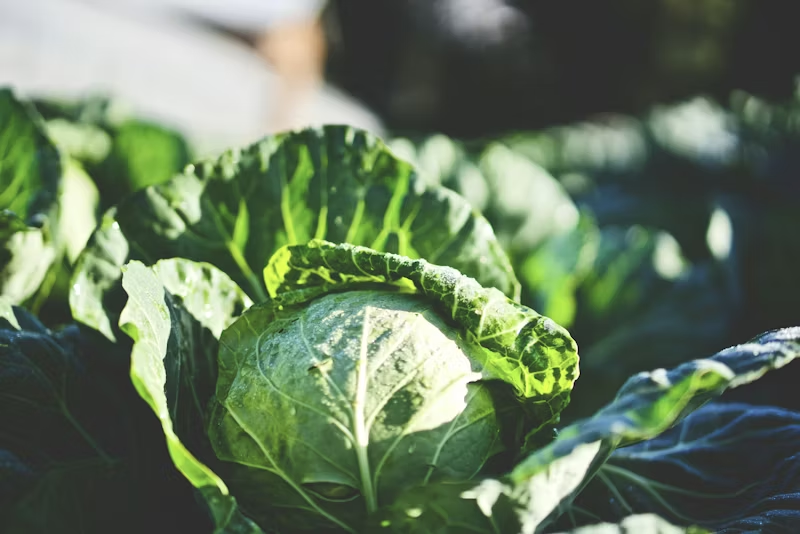

Humate — the natural soil conditioner extracted from ancient oxidized lignite layers (leonardite) — continues to gain steady popularity across continents. Its main value lies in improving soil aggregation, unlocking nutrient availability, holding water more effectively in the root zone, feeding beneficial soil microbes, and encouraging deeper root systems. Whether used in large-scale field crops, vegetable production, orchards, turf management, or home-scale organic gardening, humate performs best when sourced from reliable origins with consistent quality.
Where the Raw Material Actually Comes From
Most commercial humate originates from a limited number of geological deposits that have the right age, oxidation level, and humic substance concentration:
- United States (especially New Mexico) The San Juan Basin and surrounding areas produce some of the highest-regarded leonardite in the world. These deposits are very old, heavily oxidized, and yield humate with high humic + fulvic acid content (often 70–85% total humic substances) and low ash/sodium. Many North American suppliers position their material as “premium” or “high-performance” because of the purity and consistency.
- Canada (Alberta region) Humalite — a particularly clean and high-grade form of humate — comes from freshwater deposits in western Canada. It typically tests higher in active humic substances and lower in impurities than many lignite sources. Growers who prioritize maximum biological activity often prefer this origin.
- China China remains the single largest producer and exporter by volume. Deposits are spread across several provinces (Inner Mongolia, Xinjiang, Shanxi, and others). Quality varies widely: top-tier Chinese leonardite can reach 60–75% humic substances, while lower grades drop below 40%. Most potassium humate flakes, powders, granules, and liquids sold globally come from Chinese processing plants.
- Other Producing Countries
- India: Growing production, often mid-range quality, competitive pricing.
- Ukraine: Traditional lignite-based humates, historically strong in Eastern Europe.
- Germany: Smaller volume but high refinement and specialized formulations.
- South Africa: Leonardite from certain coal-associated deposits, used regionally and exported.
- Australia: Emerging production focused on local and Asia-Pacific markets.
- Russia, Turkey, Pakistan, and parts of Central Asia also contribute smaller volumes.
Main Types of Global Suppliers You Will Encounter
1. Direct Mining & Premium Processing Companies (mostly North America) These organizations own or lease the deposit, mine the raw leonardite, and process it with minimal additives. They usually offer granular, coarse, powder, and liquid/soluble forms. Emphasis is on high humic/fulvic percentages, low heavy metals, and suitability for certified organic use. Best suited for growers who want top consistency and are willing to pay a premium.
2. Large-Scale Manufacturers & Exporters (primarily China) Hundreds of factories specialize in turning raw leonardite into finished products: super potassium humate flakes (90–95% solubility, 50–70% humic acid), shiny flakes, ultra-fine powders, granular soil conditioners, and concentrated liquids. Many hold multiple certifications (OMRI, ISO, SGS, REACH, etc.) and export containers to over 80 countries. This is the most common source for bulk purchases and mid-range pricing.
3. Specialized European & Other Regional Processors Smaller to medium-sized companies focus on high-refinement products — often liquid humates, fulvic-dominant extracts, or custom blends. They serve local markets plus export to neighboring countries and sometimes further afield. Quality is usually very good, but volumes and pricing reflect smaller scale.
4. Global Trading Companies & Distributors These intermediaries aggregate humate from multiple origins (China + USA + others), offer blended formulations, private labeling, and handle logistics for importers worldwide. They are the main bridge between large producers and end-users in regions without local deposits.
5. Online B2B Marketplaces & Aggregators Platforms list thousands of suppliers, allowing direct comparison of specifications, prices, minimum order quantities (usually 1–25 tons), and shipping terms. Many verified suppliers provide samples (often 1–5 kg) for lab testing before committing to full containers.
How to Actually Find and Choose a Supplier in 2025–2026
- Decide exactly what you need first
- Granular for direct soil incorporation?
- Highly soluble flakes/powder for fertigation or foliar?
- Liquid concentrate for easy handling?
- Certified organic (OMRI, ECOCERT, etc.)?
- Target humic acid % (50%+, 65%+, 80%+)?
- Start with major B2B platforms Search using terms like “potassium humate flakes 60%”, “leonardite humic acid granular OMRI”, “high fulvic humate liquid”. Filter by verified suppliers, transaction history, and certification documents.
- Request documentation upfront Ask for:
- Certificate of Analysis (recent lab test showing humic + fulvic %)
- Heavy metal analysis
- Solubility test results (especially for flakes/powder)
- Organic certification if claimed
- MSDS / Safety Data Sheet
- Order samples before bulk Most serious suppliers send 1–5 kg samples (shipping cost usually USD 30–100). Test solubility, color, odor, and — if possible — run a small field trial.
- Compare landed cost Include freight (sea freight for containers, air for samples), customs duties, local clearance fees, and inland transport. Chinese material is usually cheapest on a per-ton basis; North American is highest.
Humate Price Reference Table (Early 2026)
| Origin / Product Category | Product Form | Typical Humic Substances Content | Price Range (USD / Metric Ton, FOB) | Key Notes |
|---|---|---|---|---|
| United States (New Mexico / North Dakota) | Granular / Powder | 70–85% | 195 – 270 | Premium quality, high purity, low impurities; favored for organic systems |
| United States | Liquid / Soluble Concentrate | 10–20% (liquid equivalent) | 400 – 800 (dry basis equivalent) | Higher cost due to processing; used in fertigation and foliar applications |
| Canada (Alberta humalite deposits) | Granular / Powder | 75–90% | 250 – 500 | Exceptional purity and bioactivity; competitive production cost at source |
| China (Inner Mongolia, Xinjiang, Shanxi) | Potassium Humate Shiny Flakes | 50–70% humic acid | 300 – 800 | Dominant export volume; most cost-effective for bulk agricultural use |
| China | Super Potassium Humate Flakes (high-grade) | 70–98% solubility, 60–80% humic | 600 – 1,300 | High solubility, often OMRI/SGS certified; ideal for foliar/fertigation |
| China | Standard Powder / Granular | 45–65% | 300 – 600 | Lowest cost per ton for large container orders |
| India / Ukraine / South Africa / Others | Potassium Humate / Humic Acid | 50–75% | 400 – 900 | Mid-range pricing; regional strengths in specific formulations |
| Europe (Germany and refined producers) | Liquid / Fulvic-dominant | 60–85% | 500 – 1,200 | Advanced processing; higher price reflects refinement and quality control |
Additional Pricing Notes:
- Prices listed are FOB (Free On Board) at origin ports or typical export quotations. CIF (Cost, Insurance, Freight) delivered prices usually increase by USD 100–300 per metric ton depending on destination port and shipping route.
- Small orders (<1 metric ton) incur significantly higher unit costs, often equivalent to USD 1–3 per kg or more when purchased in retail packaging (e.g., 25 kg bags).
- In regional markets such as Vietnam, imported potassium humate (25 kg bags) typically retails between approximately USD 30–58 per bag (equivalent to USD 1,200–2,320 per metric ton landed), depending on grade, importer margins, and local distribution.
- Market outlook for 2026 indicates stable to slightly upward pricing trends driven by sustained demand for sustainable soil amendments and variable freight costs.
Realistic Limitations When Sourcing Globally
- Quality variation is still very real — especially within the same country.
- Lead times for full containers can be 4–12 weeks depending on port congestion and production schedule.
- Freight costs remain volatile (influenced by fuel prices, container availability, and geopolitical factors).
- Small orders (<1 ton) are expensive per kg due to minimum charges.
- Not every supplier is equally reliable on delivery dates or after-sales support.
Key Limitations and Market Realities
Pricing fluctuates due to raw material availability, energy costs, freight volatility, and seasonal demand. Small orders incur significant per-unit premiums. Quality variation persists, particularly in high-volume origins—verified lab data remains essential. Humate enhances soil performance but requires integration with balanced fertilization programs.
Closing Thoughts
The global humate supply chain is mature and competitive. Serious buyers can source excellent material from North America (highest consistent quality), China (best volume-to-price ratio), or intermediate origins depending on budget, volume, and end-use requirements. The key steps remain the same: define specifications clearly, verify lab data, test samples, and calculate true landed cost. Once a trustworthy supplier is identified, long-term relationships usually deliver the best pricing and reliability. If you are working at farm scale or larger, investing time in this process pays off quickly through better soil response and more predictable results season after season.

Leave a Reply