
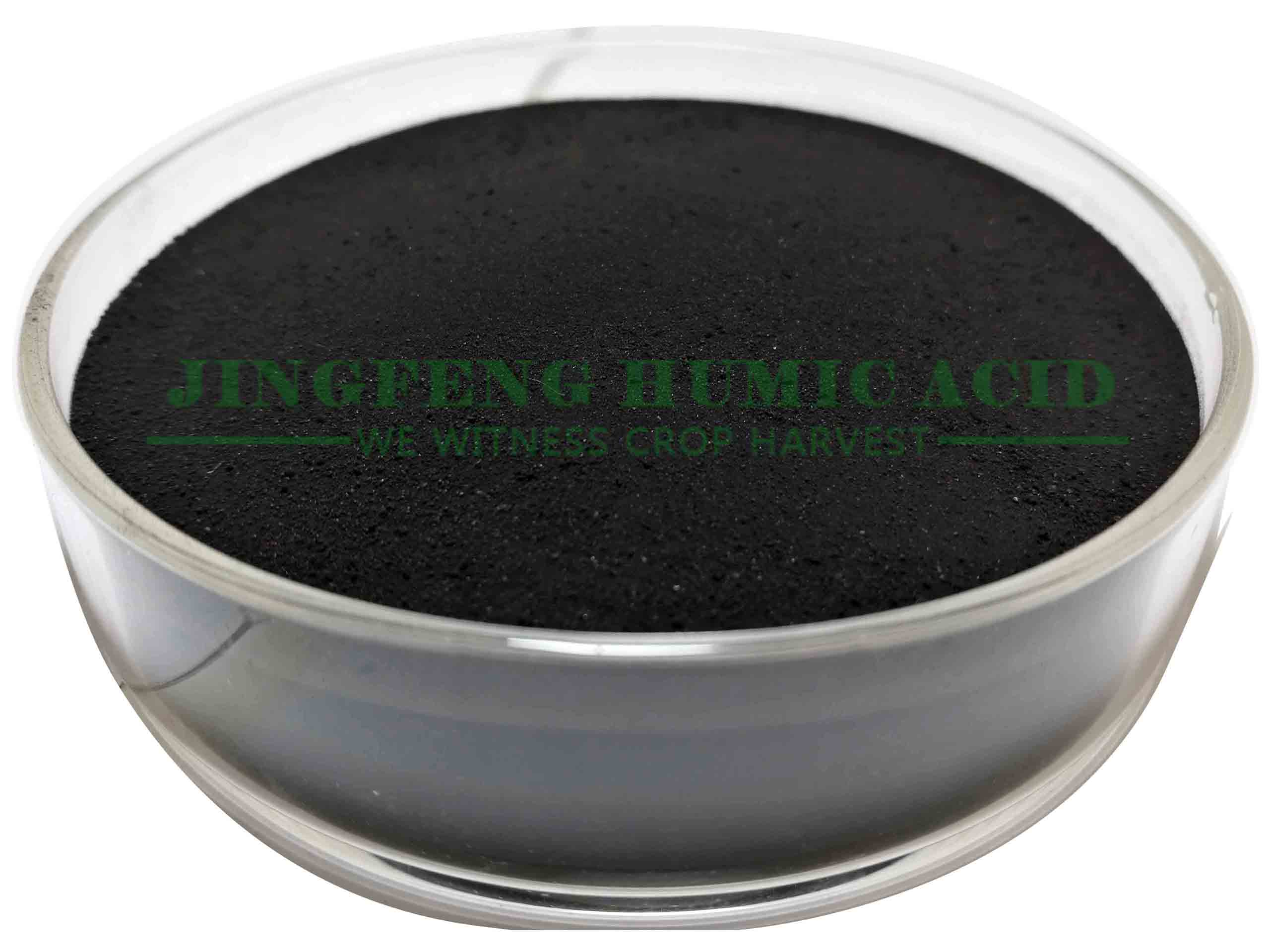
Humic Acid is a natural dark-brown to black organic substance formed over thousands to millions of years from the decomposition of plants and animals in soil, with the highest concentration found in leonardite ore. When applied to soil or sprayed on plants, humic acid loosens compacted soil, improves water and nutrient retention, powerfully stimulates white root growth, and greatly enhances the plant’s ability to absorb nutrients while building strong resistance to drought, salinity, heat, and cold.
As a result, plants stay dark green longer, suffer fewer pests and diseases, produce bigger, sweeter, better-colored fruits with higher yields, and farmers can safely reduce chemical fertilizers by 20–30 %.
Main Specification
| Parameter | Specification |
|---|---|
| Appearance | Dark brown to brown powder |
| Humic Acid (dry basis) | ≥ 70 % (typical 75–85 %) |
| Total Organic Matter (dry basis) | ≥ 85 % |
| Fulvic Acid (dry basis) | 5 – 15 % |
| Moisture Content | ≤ 15 % |
| Solubility (as potassium/sodium humate) | ≥ 98 % (in alkaline solution) |
| Insoluble Matter | ≤ 2 % |
| pH (1 % suspension in water) | 4.0 – 6.0 |
| C.E.C (Cation Exchange Capacity) | 500 – 800 meq/100 g |
| Particle Size | 80 – 200 mesh (≥ 95 % pass) |
| Bulk Density | 0.55 – 0.75 g/cm³ |
| Ash Content | ≤ 12 % |
| Heavy Metals (Pb / As / Cd / Hg) | ≤ 10 / ≤ 5 / ≤ 2 / ≤ 1 ppm |
| Total Plate Count | ≤ 10,000 CFU/g |
| Pathogens (E. coli, Salmonella) | Negative |
Main Functions
- Acts as a natural chelating agent for macro- and micronutrients (Fe, Zn, Cu, Mn, Ca…)
- Increases soil cation exchange capacity (CEC: 400–800 meq/100 g)
- Stimulates root development and seed germination
- Improves soil structure, aeration, and water-holding capacity
- Promotes beneficial microbial activity
- Buffers soil pH and detoxifies heavy metals
- Enhances plant tolerance to drought, salinity and stress
- Reduces nutrient leaching and fertilizer needs by 20–40 %
- Improves yield and quality of agricultural products
Usage / Application Methods
- Soil application (broadcast or band placement)
- Fertigation and drip irrigation systems
- Foliar spraying
- Seed treatment and seed coating
- Compost and organic manure enrichment
- Hydroponics and soilless cultivation
- Nursery and transplant root dipping
- Turf and lawn maintenance
- Remediation of saline-alkali and contaminated soils
Packaging Options
- 25 kg multi-wall kraft paper bag with inner PE liner
- 20 kg kraft paper bag with inner PE liner
- 1 kg & 5 kg aluminum foil bag
- 500–1000 kg PP woven big bag (FIBC)
- Customized private-label packaging
Key Advantages
- 100 % natural & fully biodegradable
- Reduces chemical fertilizer consumption 20–50 %
- Increases nutrient use efficiency, reduces pollution
- Compatible with nearly all agrochemicals
- Approved for organic farming (OMRI, Ecocert, EU 2019/1009)
- Non-phytotoxic, long shelf life ≥ 5 years
Storage
Cool, dry place (< 35 °C), sealed, away from strong acids and oxidants.
Shelf Life
Minimum 5 years in original packaging.